Sketchbook Rubric: Borrowing Compositional Strategies from Japanese Screens
Why folding screens matter for composition
Japanese folding screens (byōbu) present a format that encourages panoramic thinking, asymmetry, and careful use of negative space. The way elements are distributed across panels offers practical lessons for pacing and rhythm in composition. Translating those lessons into sketchbook exercises trains you to think beyond the page as a single, centred stage.
Setup and suggested materials
Use a landscape-format sketchbook or tape two pages together to approximate a wide view. A set of three markers, a graphite pencil, and a white gel or eraser for highlights is sufficient. Work from a reference, memory, or direct observation.
Three exercises (20–40 minutes each)
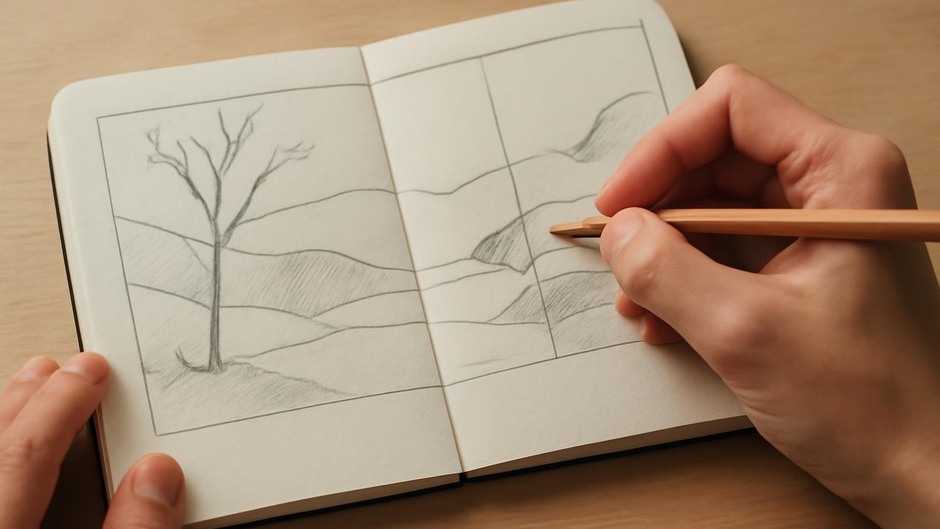
- Panel pacing (20 minutes): Divide your page into three vertical panels. Assign a role to each panel: active, quiet, and connective. Sketch simple shapes that fulfill those roles, thinking about how the eye moves from one panel to another. This cultivates a sense of pacing across a wider field.
- Asymmetry study (30 minutes): Create two thumbnail compositions: one centred, one offset. Compare how balance is achieved in each. In the offset version, use negative space to counterbalance a clustered subject. Make small notes about what felt stable and what felt strained.
- Breathing spaces (25 minutes): Start with a dominant subject on one side of the page. Create successive studies that add or remove quiet areas around it, observing how each change alters emphasis. This exercise trains restraint and the use of silence within a composition.
Mini routine for weekly practice
Set aside two short sessions a week. One session is for thumbnails and format experiments (15–25 minutes). The other is a more resolved sketch (30–45 minutes) where you choose one thumbnail and expand it, applying a limited value range to clarify form and distance.
Notes on adapting the approach
Folding screens often incorporate decorative or repeated motifs. In a sketchbook, you can try repeating a small motif across panels to create visual rhythm. Alternatively, use the panel divisions as a constraint when sketching a single subject: how does a tree look when its trunk crosses from one panel to another?
These practices turn format into a compositional tool. Rather than treating the page as a neutral container, you learn to let format shape decisions. Over time, this habit leads to more varied, confident compositional choices that feel deliberate and responsive.